

Setting up ODBC: Difference between revisions
Luke.nuttall (talk | contribs) No edit summary |
Luke.nuttall (talk | contribs) No edit summary |
||
| Line 1: | Line 1: | ||
#Open Control Panel -> Administrative Tools -> Data Sources (ODBC) | #Open Control Panel -> Administrative Tools -> Data Sources (ODBC) | ||
#Select the “System DSN” tab. | #Select the “System DSN” tab. [[Image:systemDSN.png]] | ||
[[Image:systemDSN.png]] | |||
#Click ‘Add…’ for a new DSN. | #Click ‘Add…’ for a new DSN. | ||
#Select DSN as an “SQL Server”. A window to ‘Create a New Data Source to SQL Server’ will appear. Choose the ‘Name:’ of the database added in Enterprise manager. (i.e. QESTLab_AUBOR) and enter in ‘Server:’ “(local)”. Note the DSN name has to match the name in the Enterprise manager. [[Image:newDataSourceAsSQL.png]] | #Select DSN as an “SQL Server”. A window to ‘Create a New Data Source to SQL Server’ will appear. Choose the ‘Name:’ of the database added in Enterprise manager. (i.e. QESTLab_AUBOR) and enter in ‘Server:’ “(local)”. Note the DSN name has to match the name in the Enterprise manager. [[Image:newDataSourceAsSQL.png]] | ||
#Click next -> next | #Click next -> next | ||
#Change the default database to the newly added database. (i.e. QESTLab_AUBOR). | #Change the default database to the newly added database. (i.e. QESTLab_AUBOR). [[Image:newDataSourceAsSQL2.png]] | ||
[[Image:newDataSourceAsSQL2.png]] | |||
#Click ‘Next’ and ‘Finish’ on the following screen. | #Click ‘Next’ and ‘Finish’ on the following screen. | ||
Revision as of 03:29, 1 February 2006
- Open Control Panel -> Administrative Tools -> Data Sources (ODBC)
- Select the “System DSN” tab.
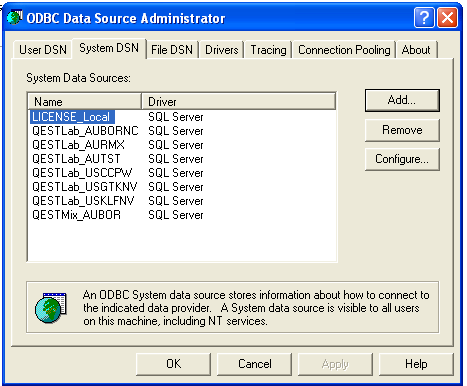
- Click ‘Add…’ for a new DSN.
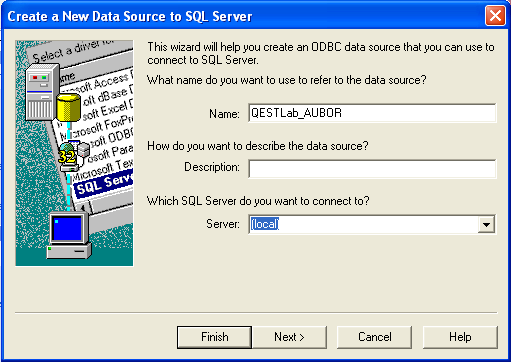
- Select DSN as an “SQL Server”. A window to ‘Create a New Data Source to SQL Server’ will appear. Choose the ‘Name:’ of the database added in Enterprise manager. (i.e. QESTLab_AUBOR) and enter in ‘Server:’ “(local)”. Note the DSN name has to match the name in the Enterprise manager.
- Click next -> next
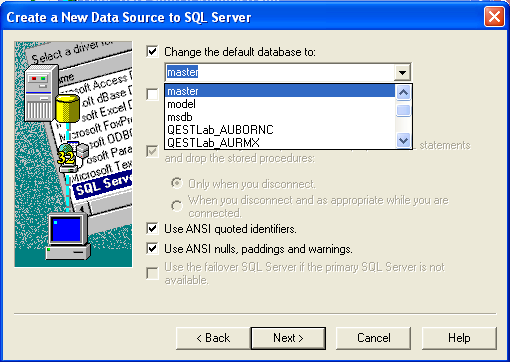
- Change the default database to the newly added database. (i.e. QESTLab_AUBOR).
- Click ‘Next’ and ‘Finish’ on the following screen.


